

A $2 million real estate allocation can look disciplined on paper and still create the wrong kind of concentration. That is the real question behind private equity real estate vs direct ownership. This is not simply a choice between owning a building yourself or wiring capital into a fund. It is a decision about governance, execution burden, legal exposure, tax architecture, and whether your capital is positioned to compound through a system rather than through a single asset.
For accredited investors, family offices, and cross-border allocators, the distinction matters most when markets stop rewarding casual ownership. In stable periods, direct ownership can feel intuitive. In more fragmented cycles, institutional process tends to matter more than intuition. The better structure depends less on ideology and more on what kind of control you actually want, what kind of risk you are prepared to absorb, and whether you are buying property or underwriting an operating machine. Understanding private equity real estate vs direct ownership is how serious capital gets that question right.

Private equity real estate vs direct ownership: the real distinction
Direct ownership gives an investor title to a specific asset, usually with direct decision-making authority over financing, leasing, renovation, sale timing, and property-level operations. The appeal is obvious. You can see the asset, inspect the assumptions, and act without waiting for committee approval from a manager.
But direct ownership also means direct exposure to every operational failure. Vacancy, contractor disputes, title issues, litigation, delayed permits, insurance friction, tax complexity, and refinancing pressure all sit close to the capital stack. In practice, many investors who believe they are buying control are actually buying responsibility.
Private equity real estate operates differently. The investor owns an interest in a professionally managed vehicle rather than the deed to the property itself. That structure separates economic participation from day-to-day execution. The manager controls sourcing, underwriting, debt strategy, legal structuring, capex oversight, reporting, compliance, and monetization. The investor is not passive in the economic sense, but is passive in the operational sense.
For sophisticated capital, that distinction is often the point. The question is not whether one structure is more real than the other. It is whether the asset should be managed as a standalone holding or as part of a disciplined platform.
When evaluated with rigor, private equity real estate vs direct ownership is not a debate about which feels more tangible. It is a question about where value is actually created — and by whom.
Control is not always what it seems
Direct ownership is often framed as the superior route because the investor retains authority. That is true at the legal level. It is less true at the practical level unless the investor has local market command, transaction access, trusted operators, and the time to govern execution with precision.
Owning one or two assets directly can create the illusion of autonomy while producing dependency on brokers, lenders, attorneys, contractors, and property managers whose incentives are not fully aligned. Every decision remains yours, but every outcome depends on counterparties you do not fully control.
In private equity real estate, the investor surrenders asset-level discretion in exchange for manager-level discipline. That trade can be attractive when the GP has institutional controls, deep sourcing relationships, and a repeatable operating model. For many allocators, the goal is not to decide the paint color or negotiate with a roofer. The goal is to approve an investment thesis, review governance, and monitor whether the manager executes inside mandate.
This is where weaker operators and stronger operators diverge sharply. If the GP lacks underwriting rigor, reporting quality, or legal architecture, reduced control becomes a liability. If the GP has superior sourcing, compliance, and operating control, delegated execution can become an advantage.
The difference between asset control and process control
Sophisticated investors tend to overvalue visible control and undervalue process control. Direct ownership gives visible control over a single asset. Private equity, at its best, gives process control over the full investment cycle — from acquisition discipline to capital deployment, risk review, exit timing, and reinvestment logic.
That difference becomes especially relevant in value-add or special situation strategies, where returns are often created through speed, access, and execution quality rather than passive market appreciation.
Reframing private equity real estate vs direct ownership as a question of control type rather than control quantity clarifies why institutional allocators consistently prefer managed vehicles over isolated assets when deploying at scale.
Concentration, diversification, and the hidden cost of simplicity
One of the strongest arguments for direct ownership is simplicity. There is one property, one balance sheet, one business plan. Yet simplicity at the asset level can create concentration at the portfolio level.
A direct purchase often leaves an investor heavily exposed to a single location, a single tenant profile, a single financing structure, and a single exit event. If the business plan slips, there is no internal portfolio diversification to absorb timing risk.
Private equity real estate can dilute some of that concentration, depending on the strategy. A fund may hold multiple assets, staggered acquisitions, or repeated shorter-duration cycles. That can smooth some asset-specific volatility, although it does not eliminate manager risk. Instead of concentration in one property, the investor assumes concentration in the quality of the manager and the strength of the platform.
Neither form of concentration is inherently better. The relevant question in private equity real estate vs direct ownership is which concentration risk the investor is best positioned to monitor and absorb.
Liquidity, duration, and capital pacing
Neither route should be mistaken for highly liquid exposure. Real estate is real estate. Capital tends to move slowly relative to public markets.
Direct ownership may appear more flexible because the owner can decide when to sell. In reality, liquidity is constrained by buyer demand, debt conditions, tax considerations, title readiness, and market timing. You have discretion, but not immediate liquidity.
Private equity real estate usually imposes formal lockups, capital call schedules, distribution waterfalls, and defined exit windows. That is less flexible on paper. It can be more efficient in practice if the strategy is built around disciplined monetization rather than indefinite holding periods.
For investors managing larger portfolios, capital pacing often matters more than nominal liquidity. A manager who can source, execute, exit, and redeploy capital with precision may create a more coherent compounding profile than an investor holding a single asset and waiting for the right sale window.
Structured for Sophisticated Capital
Private equity real estate vs direct ownership: the answer depends on your edge — and on the platform executing the strategy.
See how Arcsa Capital builds cross-border real estate allocations with institutional governance, disciplined underwriting, and legal architecture designed for serious capital.
Talk to Our Investment Team →Tax structure and legal architecture are not side issues
For domestic and especially international investors, the comparison between private equity real estate vs direct ownership often turns on tax and liability architecture more than on headline return targets.
Direct ownership can be tax efficient in the right structure, but it may also create administrative complexity, estate planning concerns, FIRPTA exposure for foreign investors, filing obligations, and direct legal visibility. The property is yours, and so are many of the complications around ownership.
A properly structured private equity vehicle can centralize governance, standardize reporting, and create more deliberate tax planning around entity design, withholding, and investor onboarding. This is particularly relevant for cross-border capital that values clean legal wrappers, strong administrator oversight, and institutional reporting standards.
Not every fund structure is elegant. Some add layers without adding protection. But when structured correctly, the fund format can provide a degree of legal and fiscal order that direct ownership rarely achieves at equivalent scale.
Access changes the equation
The most overlooked factor in this comparison is access. Direct ownership assumes the investor can identify, underwrite, and close on quality assets at reasonable prices. In competitive markets, that is a significant assumption.
Institutional sponsors with sourcing infrastructure, repeat relationships with sellers, and the ability to close without contingencies often access opportunities that are not available to individual buyers. In residential value-add and special situations, the spread between a well-sourced opportunity and a widely shopped asset can be significant. That spread is often where much of the return is created.
The decision between private equity real estate vs direct ownership is therefore also a decision about sourcing capability. If the investor has genuine proprietary deal flow, direct ownership can be efficient. If access depends on the open market, partnering with an institutional platform may produce better risk-adjusted outcomes.
When direct ownership still makes sense
Direct ownership remains compelling in certain cases. It can fit investors who want concentrated conviction, have deep local operating expertise, prefer full discretion over debt and disposition, or own through structures already integrated into broader estate and tax planning.
It may also suit investors whose edge lies in patient control over a limited number of assets rather than portfolio-level deployment. If you have market access, time, and operator discipline, direct ownership can be precise and highly effective.
The issue is not that direct ownership is outdated. It is that many investors choose it for emotional reasons while underestimating the operational demands.
When private equity real estate is the stronger structure
Private equity is often the stronger choice when the investor prioritizes institutional governance, delegated execution, cleaner reporting, access to off-market opportunities, and a manager with demonstrated operational control. It is especially relevant when capital preservation matters as much as upside, and when the investor values architecture over improvisation.
For UHNW and institutional allocators, the better question is rarely, Which format feels more tangible? It is, Which structure best protects capital while allowing it to work through a controlled system?
That is where firms such as Arcsa Capital position the conversation at a higher level — not as a retail debate about owning property versus owning shares, but as a decision about whether capital should rely on isolated ownership or on an engineered platform built for sourcing, compliance, speed, and disciplined exits.
The right answer depends on your edge. If your edge is operating assets directly, own them directly. If your edge is allocating capital intelligently and selecting managers with institutional standards, private equity real estate may be the more sophisticated form of control. The asset matters, but the architecture around the asset often matters more.
In the end, private equity real estate vs direct ownership is not a binary choice between active and passive — it is a decision about which form of control produces better outcomes given the investor’s specific capabilities, time horizon, and capital structure.
Capital Architecture for International Investors
Arcsa Capital builds real estate vehicles engineered for institutional outcomes.
Legal structure, tax planning, compliance oversight, and disciplined underwriting — built for UHNW and family office capital from day one.
Talk to Our Investment Team →Weighing direct ownership against a private real estate fund?
ARCSA Capital provides institutional exposure to prime Miami residential assets with private sourcing and in house execution.
Request InformationContents
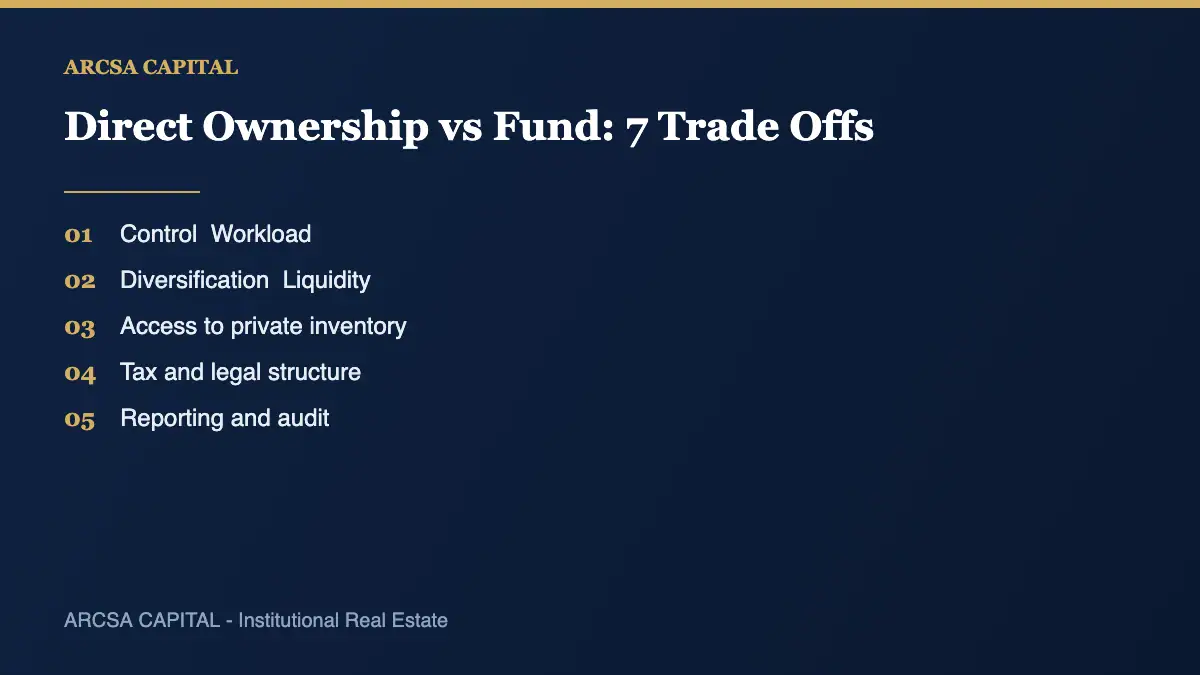
Direct Ownership: 7 Points at a Glance
The comparison is usually framed as control against convenience, which is too simple. The seven trade offs below describe what actually changes when an investor moves between direct ownership and a private equity real estate vehicle.
- Control. Direct ownership gives control over the asset. A fund gives exposure to a process. Investors who conflate the two are usually disappointed by whichever one they chose.
- Workload. Sourcing, financing, construction, leasing, compliance and disposition all sit with the owner personally in a direct structure.
- Diversification. One property is one submarket, one vintage and one exit. A fund spreads that across several assets, which changes the shape of the outcome rather than its average.
- Liquidity. Direct ownership can be sold at any time in theory, subject to finding a buyer. A fund interest is illiquid by design but returns capital on a defined schedule.
- Access. Institutional sourcing channels, private inventory and scale pricing are difficult to replicate individually, which is where a fund earns its fees or fails to.
- Tax and legal structure. Ownership entity, liability isolation, withholding and estate exposure differ materially between direct ownership and a pooled interest.
- Reporting. A fund is obliged to report and be audited. A direct owner reports to no one, which is a freedom and, in practice, a gap.
None of these trade offs makes one route universally superior. Direct ownership suits investors with time, local capability and a preference for control. A pooled vehicle suits investors seeking exposure with professional execution. The error is choosing without naming which constraint matters most.
What Regulators and Public Filings Reveal About Direct Ownership
A pooled vehicle sold to qualified investors operates under federal rules on private offerings, investor verification, conflicts disclosure and fiduciary conduct. Those obligations create documentation and accountability that direct ownership simply does not produce, because there is no counterparty to disclose to.
Direct ownership carries its own public footprint. Title, mortgages, liens, permits and code enforcement are all recorded, which means the owner is responsible for a compliance record that becomes visible at resale. Unpermitted work discovered at exit is one of the most common and most expensive consequences.
Tax treatment separates the two routes more than most investors expect. Entity selection, liability isolation, withholding at disposition for non residents and estate exposure on United States situs assets all differ, and the decision made at acquisition governs the outcome years later.
Investors comparing routes should confirm how a sponsor qualifies investors, discloses conflicts and reports results, and should take independent tax advice on the structure. The investor guidance published by the U.S. Securities and Exchange Commission is a practical benchmark for what a pooled vehicle provides and direct ownership does not.
Common Mistakes Investors Make With Direct Ownership
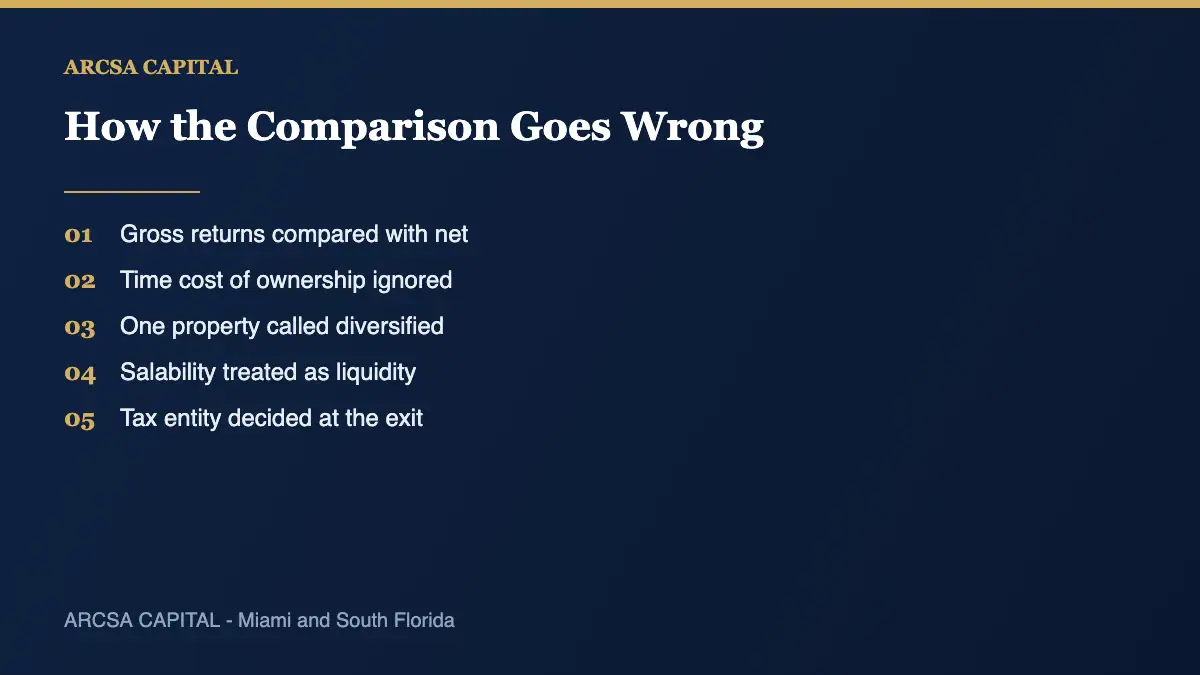
The recurring errors come from choosing a route for a reason that does not survive contact with the work involved.
- Choosing direct ownership for control and then delegating every operational decision anyway.
- Assuming a single property is diversified because the submarket is considered strong.
- Underestimating the time cost of construction management, leasing and compliance.
- Treating theoretical salability as liquidity in a market where absorption is thin.
- Selecting a fund for access without verifying that its sourcing is genuinely proprietary.
- Ignoring the tax and estate consequences of the ownership entity until the exit.
- Comparing gross returns on direct ownership against net returns on a fund interest.
The comparison only works when both routes are measured the same way: after all costs, after the value of the investor own time and after tax.
How to Evaluate Direct Ownership in 30 Days
Week 1 – Name the binding constraint
Decide whether the scarce resource is time, capital, local capability or tax flexibility. Direct ownership is a poor fit whenever time or local execution capability is the constraint, and no return assumption changes that.
Week 2 – Cost both routes honestly
Model direct ownership with financing, insurance, taxes, association dues, management, maintenance, vacancy and transaction costs, and assign a value to the hours required. Then model the fund net of all fees. Compare only the two net figures.
Week 3 – Test access and execution
If considering a fund, verify that sourcing is genuinely private and that construction capability is in house. If considering direct ownership, confirm you already have a contractor, a permitting path and a property manager, not in principle but by name.
Week 4 – Resolve structure and tax
Take advice on entity, liability isolation, withholding and estate exposure for both routes. For cross border investors this step frequently reverses the preliminary conclusion, because direct ownership can carry estate consequences a pooled interest avoids.
Frequently Asked Questions About Direct Ownership
Does direct ownership really give more control?
It gives control over the asset: what to buy, what to spend and when to sell. It does not give control over process quality, which depends on the contractors, managers and advisers the owner can actually secure. Many investors find that asset control without process control is a thinner advantage than expected.
Is a fund always more expensive?
Not once the full cost of direct ownership is counted. Financing spreads, insurance at individual scale, management fees, maintenance, vacancy, transaction costs and the investor’s own time are frequently omitted, which makes the fund look expensive by measuring one route gross and the other net.
Which route is better for a first allocation to a new market?
Usually a pooled vehicle. It provides diversification across several assets, local execution and governance while the investor learns the market. Direct ownership in an unfamiliar market concentrates every risk at once, and the learning is paid for at full price.
How does liquidity really compare?
Direct ownership can be sold at any time provided a buyer exists at an acceptable price, which is not assured in a slow quarter. A fund interest is illiquid by design but returns capital on a schedule known in advance. The difference is between uncertain timing and known timing.
When does direct ownership clearly win?
When the investor has local capability, time, a specific asset thesis and wants use of the property as well as return. Under those conditions direct ownership removes a fee layer and preserves flexibility that no pooled structure can match.
Key Takeaways on Direct Ownership
- Name the binding constraint before comparing routes.
- Direct ownership gives asset control, not process control.
- Compare net to net, including the value of the investor own time.
- One property is one submarket, one vintage and one exit.
- A fund earns its fees through access, execution and governance, or it does not.
- Tax and estate consequences differ materially and are decided at acquisition.
- For an unfamiliar market, pooled exposure is usually the cheaper education.
ARCSA Capital offers investors institutional exposure to prime residential real estate in Miami and selected Florida submarkets, with private sourcing, in house execution and asset level reporting. This article is general information and does not constitute legal, tax or investment advice.
Direct ownership or a fund: choose by constraint, not by preference
Speak with our team about structure, tax treatment and reporting before your next allocation.
Request InformationOr model your own scenario in the investment simulator
Or receive the ARCSA Capital investment thesis by email, with the entry, stabilisation and exit assumptions behind the strategy:
